
Cleaning with hydrocarbons plays a central role in the heat treatment of metallic workpieces – both before and after the thermal process. Before heat treatment, it is crucial that components are free of oils, greases, particles, and other residues. These contaminants can lead to undesirable reactions at high temperatures, such as discoloration, oxidation, carbon enrichment, or even defects in the material structure. Thorough cleaning ensures that heat treatment takes place under controlled conditions and that the desired material properties are achieved.
Solvent-based cleaning processes are particularly effective at removing organic residues such as cutting oils, corrosion protection agents, or lubricants. They offer the advantage of rapid drying, as many solvents are volatile, and leave minimal residues—an essential factor for processes under vacuum or protective gas. Modified alcohols, hydrocarbons, or chlorinated solvents are commonly used, depending on requirements for environmental compatibility, material compatibility, and cleaning performance. In many cases, solvent cleaning is supported by ultrasound to remove even the finest particles and residues from complex geometries.
After heat treatment, oil quenching is often used. To prevent contamination of the tempering furnace, an additional cleaning step is integrated before tempering in order to protect the hot zone of the furnace.
Modern heat treatment systems increasingly integrate cleaning into the automated line and thus monitor the entire process via the control center. The batch size of the cleaning system must therefore correspond to the batch size of the furnaces.
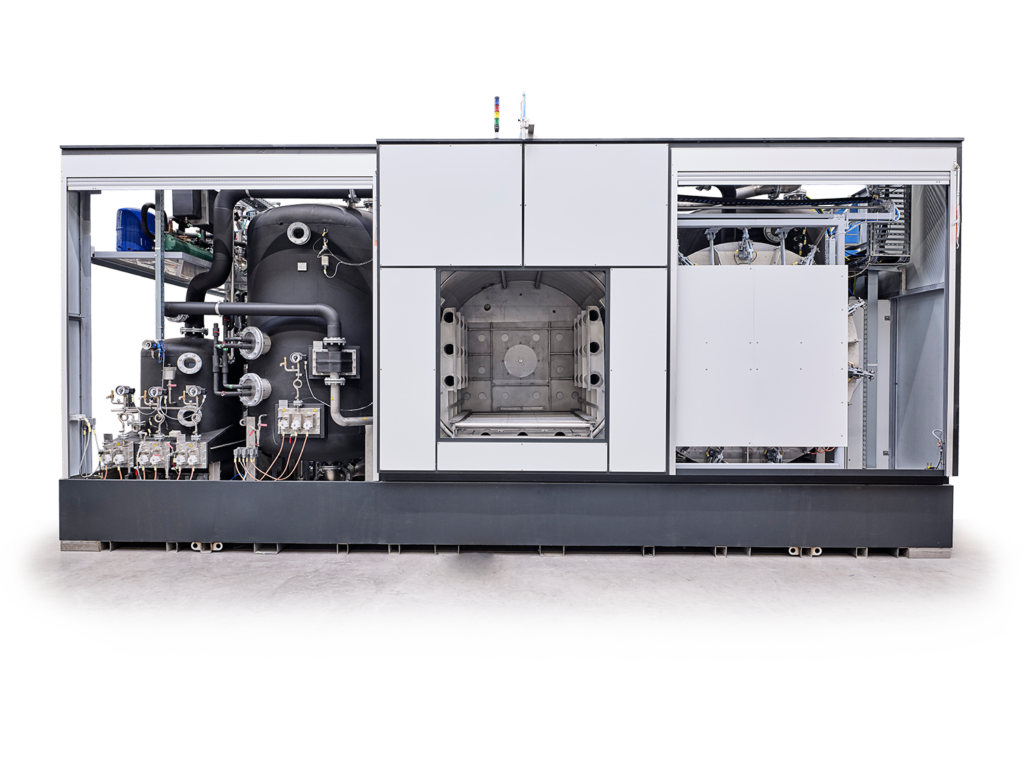
Practical example of a customized cleaning system for high-precision industrial components with the highest requirements for cleanliness, reproducibility, and process reliability.
To remove residues that could lead to surface defects or reactions at high temperatures.
Oils, greases, particles, salts, and organic contaminants.
Discoloration, oxidation, carbon enrichment, or defects can occur.
It removes the quenching oil and protects the hot zone of the tempering furnace.
For organic residues, yes – solvents are often more effective and residue-free. In contract heat treatment, hybrid systems are frequently used in order to completely remove inorganic residues as well.
Modified alcohols, hydrocarbons, mixtures thereof, and chlorinated solvents.
No, their effectiveness depends on the type of contamination and the material.
Solvents with high cleaning performance and good environmental compatibility, e.g. DOWCLENE.
Only in closed systems with recovery – due to environmental and health risks.
The components are immersed in or sprayed with solvent, often supported by ultrasonic action, then vapor-degreased and vacuum-dried.
Yes, many systems are integrated into heat treatment systems and are fully automatable.
Depending on the process and type of contamination, usually between 15 and 45 minutes.
It enhances the cleaning effect through cavitation and microcurrents.
By visual inspection, particle measurement, residue analysis, or surface inspection.
Yes, residue-free cleanliness is critical – therefore hybrid cleaning systems are preferred, which can combine solvents and aqueous media in a single cleaning chamber.
They require appropriate protective measures and closed systems.
They must be properly disposed of via the waste oil disposal system.
Yes, e.g. modified alcohols.
Ideally, the cleaning system is equipped with distillation as well as the ability to automatically discharge low boilers. This eliminates the need for complete bath replacement on a permanent basis.
The combination of solvent cleaning and ultrasonic action is particularly effective, as it also reaches hard-to-access areas such as drill holes, gaps, and internal threads.