Degreasing with perchloroethylene (PER) is a high-performance process for removing oils, greases, and organic residues from metallic components – especially prior to heat treatment. It is carried out in closed top-loading or front-loading systems designed for large and complex workpieces.
Two processes are used: during immersion cleaning, the components are completely submerged in PER, effectively dissolving contaminants. This is followed by vapor degreasing for particularly thorough final cleaning: PER vapor condenses on the cooler component surfaces, dissolves remaining residues, and evaporates without leaving any residue.
PER is characterized by high solvency power, good material compatibility, and rapid drying. As it poses health risks, it is used exclusively in closed, recovery systems that comply with strict environmental and occupational safety regulations.
Typical application areas include the automotive industry, toolmaking, aerospace engineering, and medical technology – wherever maximum cleanliness and process reliability are required.
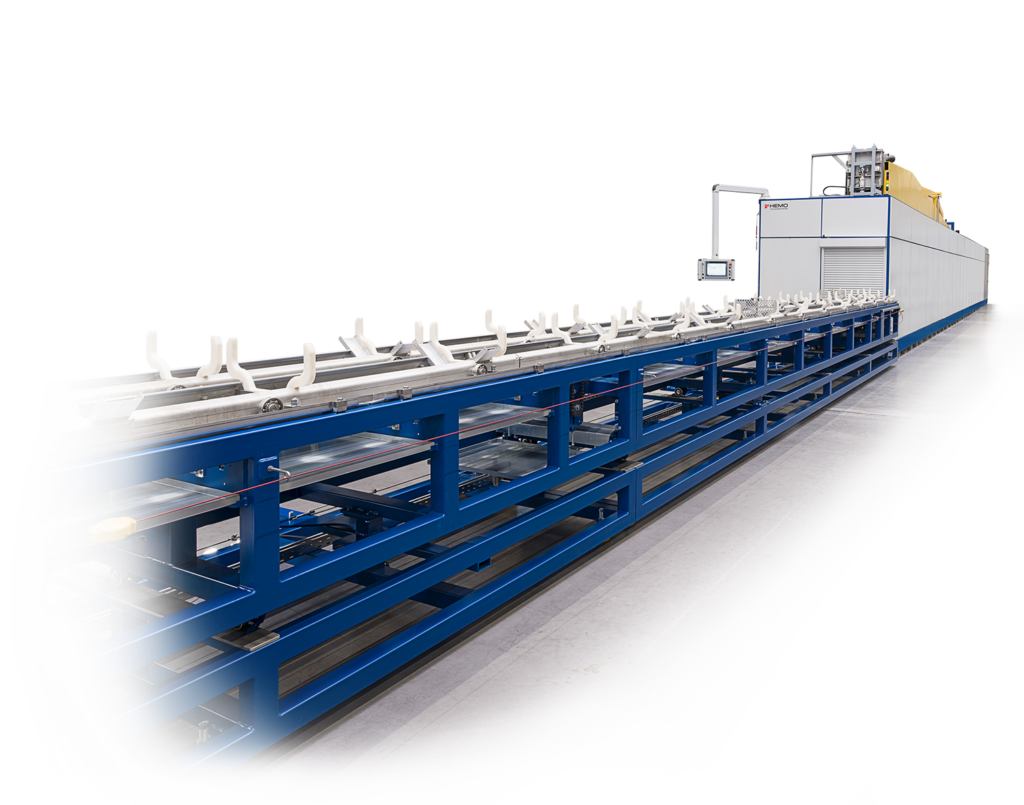
Practical example of a large-scale pipe cleaning system for stainless steel pipes in nuclear engineering applications with the highest requirements for cleanliness, throughput, and process reliability.
A chlorinated solvent with high grease-dissolving power, ideal for industrial parts cleaning.
By immersion cleaning and/or vapor degreasing in closed systems.
The components are fully immersed in PER to dissolve oils and greases.
PER vapor condenses on the components, dissolves residues, and evaporates without leaving any residue.
Closed top-loading or front-loading systems, depending on component size and handling.
It quickly dissolves organic residues and dries without leaving any residue.
Yes, thanks to its low surface tension, it also reaches hard-to-access areas.
Yes, this significantly enhances the cleaning effect.
Very fast – ideal for processes with high purity requirements.
No, it is non-flammable, which improves workplace safety.
Yes, therefore it is used only in closed, monitored systems.
Through distillation and recovery within the system.
Yes, modern systems comply with the strict emission limits.
They are collected and disposed of or recycled properly.
Yes, but only under strict safety and environmental regulations.
In the automotive, aerospace, medical technology, and toolmaking industries.
Yes, because it cleans without leaving residues and does not cause any reactions in the oven.
Depending on the system type, large and heavy parts can also be cleaned.
Typically between 15 and 45 minutes, depending on contamination, geometry, and batch size.
By visual inspection, residue analysis, or particle measurement.