In forming technology, where large quantities of components – often collected in mesh boxes – need to be cleaned, vapor degreasers or hydrocarbon flood-washing systems offer a particularly efficient solution. These systems are specifically designed for batch cleaning of large and heavily soiled metal parts, as typically generated after punching, bending, or drawing processes.
The cleaning takes place in a closed system operated with hydrocarbon solvents. These solvents are highly effective against oils, greases, and drawing agents while remaining gentle on materials. After a pre-spray, which directs the majority of oils directly into the evaporator, a single flood-wash process is carried out. In the subsequent vapor degreasing process, solvent vapors rise from a heated bath and condense on the cooler component surfaces. The condensation dissolves the residues, which are carried away with the solvent. The solvent then fully evaporates, leaving the components dry and residue-free when removed from the system.
This method is particularly advantageous when cleaning entire mesh boxes, as it can handle large volumes in a short time and integrates well into automated production processes. Modern systems feature solvent recovery, explosion protection, and process monitoring to ensure both safety and environmental compliance. Continuous-flow systems allow very short cycle times while maintaining a separation between the dirty and clean areas of the system.
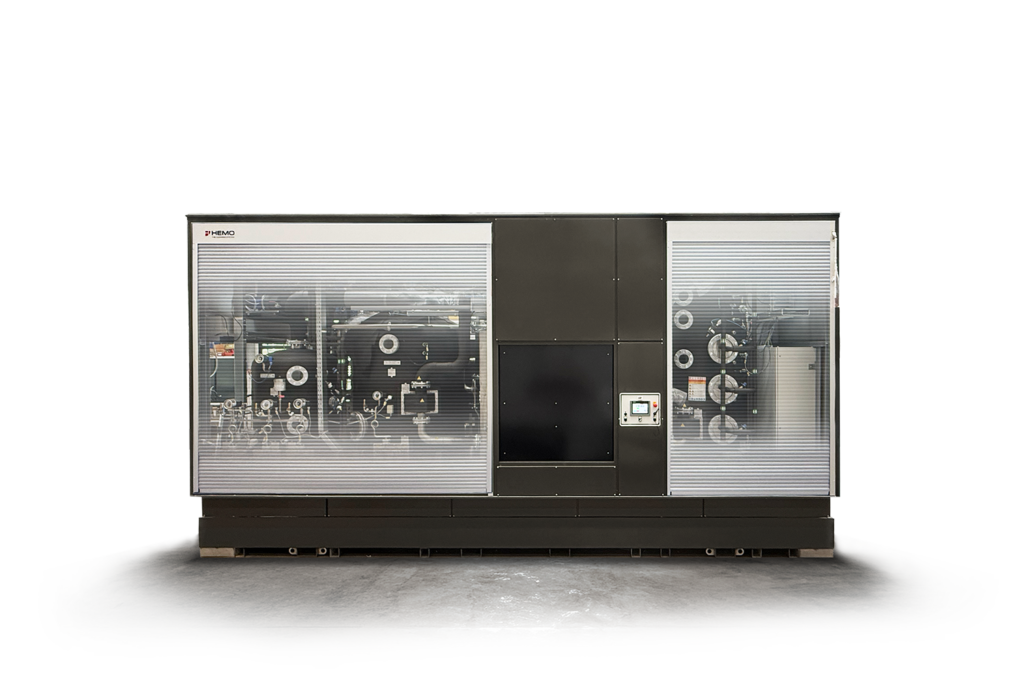
Practical example of a linked cleaning and coating system for hydraulic units, designed for maximum throughput, process reliability, and sustainability.
A cleaning process in which solvent vapor condenses on components, removing organic residues.
They have a high dissolving power for oils and greases and are gentle on materials.
The entire box is loaded into the system and cleaned in a closed cycle.
The solvent vapor condenses on the cool components and dissolves the contaminants.
The solvent fully evaporates under vacuum, leaving the parts dry and residue-free.
Closed vapor degreasing systems with automatic loading and solvent recovery.
Yes, they are specifically designed for cleaning mesh boxes and large-scale series.
Depending on the level of contamination and load, usually between 10 and 30 minutes.
Yes, for the additional removal of fine particles.
Through distillation and filtration within the system.
They are highly flammable, but this is mitigated by the vacuum technology of modern cleaning systems.
Through closed vacuum systems, fire protection technology, and process monitoring.
Yes, for example to limit emissions and enable solvent recovery.
Yes, modern systems operate almost emission-free.
They are collected, treated, or disposed of properly.
Stamped parts, deep-drawn parts, bent parts, and other formed products.
Yes, through automated processes and documented cycle data.
Yes, with adjusted parameters and suitable solvents.
Through visual inspection, residue analysis, or particle measurement.
Yes, especially for large quantities and high cleaning requirements.