

Ultrasonic precision cleaning in the frequency range of 25 to 40 kHz is a proven method for removing particulate contamination from sensitive or complex components. It is based on the physical principle of cavitation, which is triggered by high-frequency sound waves in a solvent bath. Tiny vapor bubbles are formed as a result of alternating pressure and negative pressure in the liquid. These bubbles grow and eventually collapse with high energy – a process that generates microscopic pressure and temperature peaks as well as strong microflows.
In the range of 25 to 40 kHz, cavitation is particularly intense. The bubbles are larger, and their implosion releases more mechanical energy than at higher frequencies. This makes this range ideal for cleaning robust materials such as metal, glass, or ceramics, where even stubborn contaminants such as polishing residues, abrasion, or production residues can be reliably removed. At the same time, the cleaning process is gentle enough not to mechanically stress sensitive geometries or fine structures.
The choice of frequency within this range depends on the application: at 25 kHz, particularly strong cavitation is generated, making it suitable for coarse contamination. Frequencies of 30 to 35 kHz offer a good balance between cleaning performance and material protection, while 40 kHz already enables finer cleaning, for example for electronic or precision mechanical components.
In addition to frequency, decisive factors for cleaning performance include the choice of solvent, the bath temperature (usually optimally between 70 and 85 °C), and the duration of the cleaning process. The combination of these parameters enables highly effective, reproducible, and material-friendly cleaning – even in hard-to-reach areas such as drill holes, gaps, or complex internal geometries.
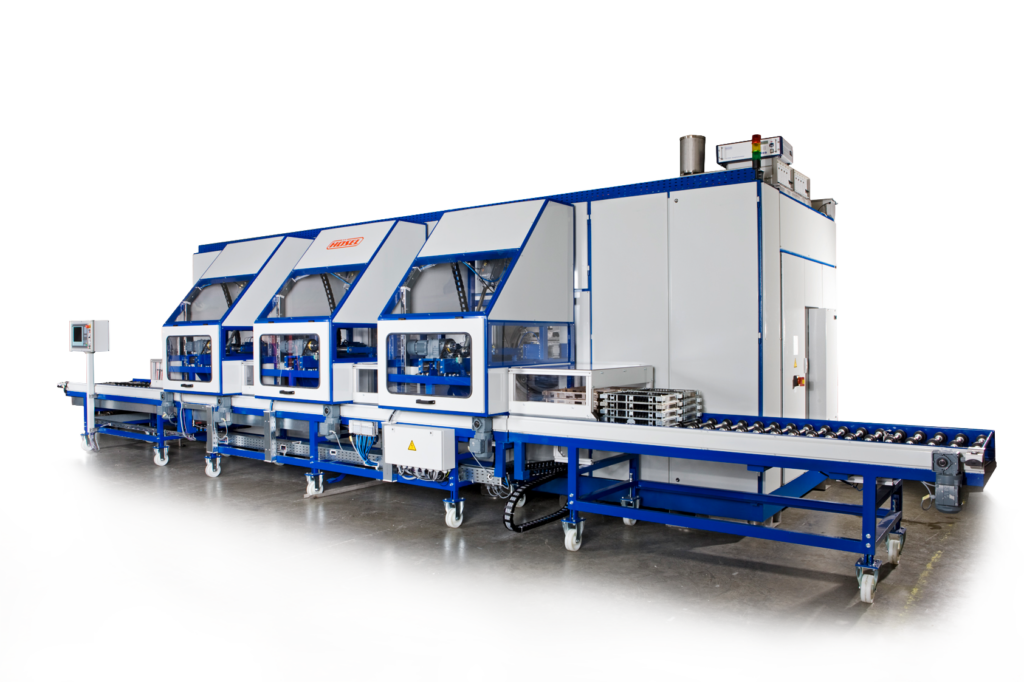
Practical example of a hybrid cleaning system for pharmaceutical autoinjectors with the highest requirements for cleanliness and process reliability.
A cleaning process that removes particulate contamination using sound waves and cavitation.
Ultrasound generates bubbles in the liquid bath that implode and thereby detach dirt.
This frequency range generates strong cavitation – ideal for removing stubborn contamination.
Microflows and pressure peaks are generated, which dislodge dirt particles from surfaces.
It supports cavitation and additionally dissolves filmic as well as all organic contaminants.
Metal, glass, ceramics, plastics – depending on sensitivity, frequency selection, and permissible solvent temperature.
Yes, with the correct frequency selection and process control, it is very gentle.
Optics, medical instruments, electronic components, metallic precision parts.
Yes, cavitation also acts in bores, gaps, and hard-to-reach areas.
For capillaries, CNP (cyclic nucleation) can additionally be used.
Depending on the level of contamination and the material, usually between 8 and 20 minutes, depending on the batch size.
Usually between 70 and 85 °C – supporting cavitation and cleaning performance.
25 kHz generates the most intense cavitation, but also the highest mechanical stress.
For sensitive components or finer contamination – gentler cleaning.
Hydrocarbons, chlorinated hydrocarbons, modified alcohols, or mixtures thereof with a flash point greater than 55 °C.
Higher power = stronger cavitation = more intensive cleaning.
Yes, with controlled process parameters, it is highly reproducible.
If the power is too high or the frequency is incorrect, sensitive surfaces can be damaged.
Visual inspection, particle measurement, surface tension testing.
Ideally, the cleaning system is equipped with distillation as well as the capability to automatically discharge low-boiling components. This permanently eliminates the need for a complete bath change.
Yes, many systems are fully automatable and suitable for series production processes.