

Modern solvent cleaning systems are no longer limited to metallic materials. Thanks to advanced processes and precise process control, they can also reliably and gently clean plastics, composites, and hybrid components. This is particularly relevant in industries such as medical technology, electronics manufacturing, and automotive production, where components increasingly consist of multiple materials.
The solvents used – such as modified alcohols or hydrocarbons – are highly compatible with different materials. They do not attack sensitive surfaces, are residue-free, and can be used safely and efficiently in closed systems. Cleaning is typically carried out through flood washing, spraying, or vapor degreasing, often supported by ultrasonic treatment to remove even the finest particles and film-like residues.
Hybrid components, for example made of metal and plastic, present special cleaning challenges: differing surface energies, thermal sensitivities, and chemical reactions must be considered. Modern systems offer individually programmable cleaning cycles tailored to each material combination.
Through the combination of automated process control, precise temperature regulation, solvent recovery, and optional preservation, these systems have become an integral part of modern manufacturing processes – even for complex and sensitive components.
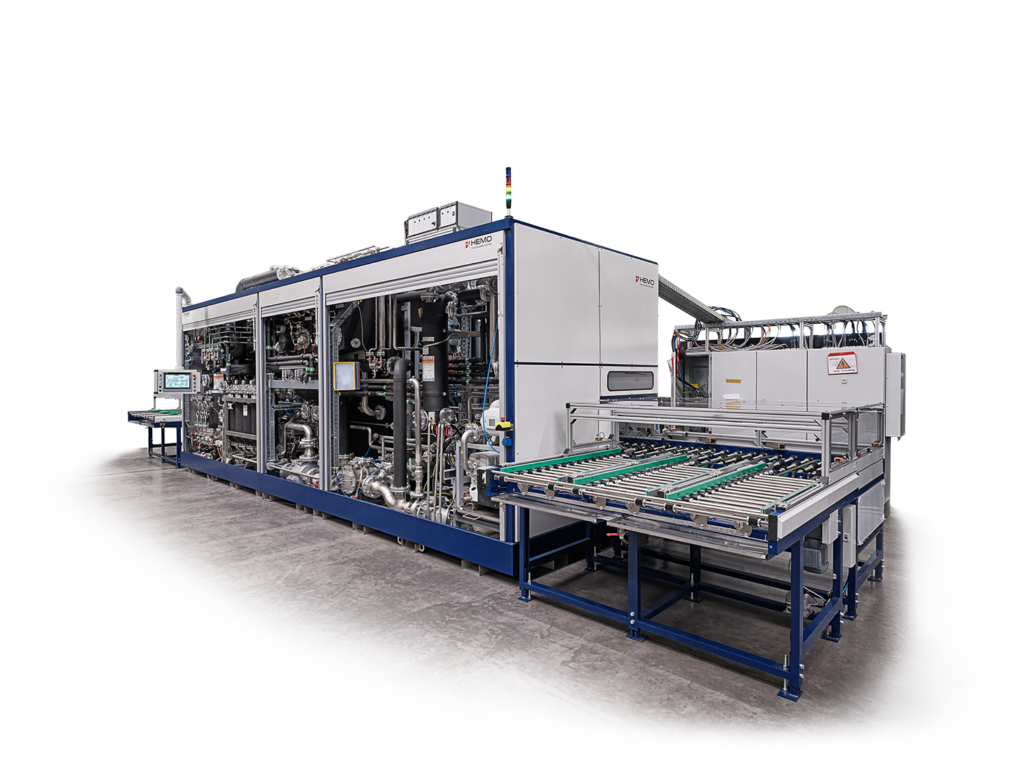
Practical example of a continuous-flow system for particle-free fine cleaning of metal components with the highest demands on cleanliness, throughput, and process safety.
No, they also clean plastics, composites, and hybrid components.
Components made of multiple materials, e.g., metal-plastic combinations.
Many technical plastics such as PEEK, PA, PC, ABS – depending on solvent and temperature compatibility.
Modern solvents are gentle on materials and specially formulated for sensitive surfaces.
Through preliminary tests, manufacturer approvals, or chemical resistance lists.
Through flood washing, spraying, vapor degreasing, and, if applicable, ultrasonic cleaning in closed systems.
Yes, they can be individually tailored to the material and level of contamination.
Through precise temperature and process control as well as carefully selected solvents.
Yes, with adjusted frequency and power to prevent micro-damage.
Typically through vacuum drying – fast and residue-free.
Through visual inspection, particle measurement, residue analysis, or surface testing.
Yes, for example, differing expansion or chemical reactions – therefore careful process selection is necessary.
Yes, they are highly automated and designed for large quantities.
Through sensors, process monitoring, and documented batch tracking.
Yes, using gentle processes and suitable solvents.
Yes, thanks to closed loops, solvent recovery, and low emissions.
Through distillation and filtration within the closed loop.
Yes, for example, to limit emissions, ensure workplace safety, and control solvent use.
They are collected and properly disposed of or recycled.
Yes, modern systems are optimized for minimal energy and solvent consumption.