In today’s industrial manufacturing, cleaning systems must be highly automated to minimize labor while ensuring high process reliability and cleaning quality. Automation begins with loading and unloading, which can be handled by robots, conveyor systems, or automatic lifting devices – ideal for mass production and large batches such as grid boxes.
The cleaning processes themselves are program-controlled and automatically adapt to the type of component, level of contamination, and material. The system detects, via sensors or barcode systems, which cleaning steps are required and performs them without manual intervention. Solvents and aqueous media are automatically dosed, filtered, recycled, and monitored – including level control, replenishment, and media monitoring.
Additionally, modern systems feature self-diagnosis functions, automatically report maintenance needs, and allow remote maintenance by the manufacturer. Integration with ERP or MES systems enables complete batch tracking, process documentation, and production planning.
This comprehensive automation not only reduces labor requirements but also increases reproducibility, quality assurance, and cost-efficiency – a decisive advantage in industries with high throughput and strict standards such as automotive, medical technology, aerospace, or semiconductor manufacturing.
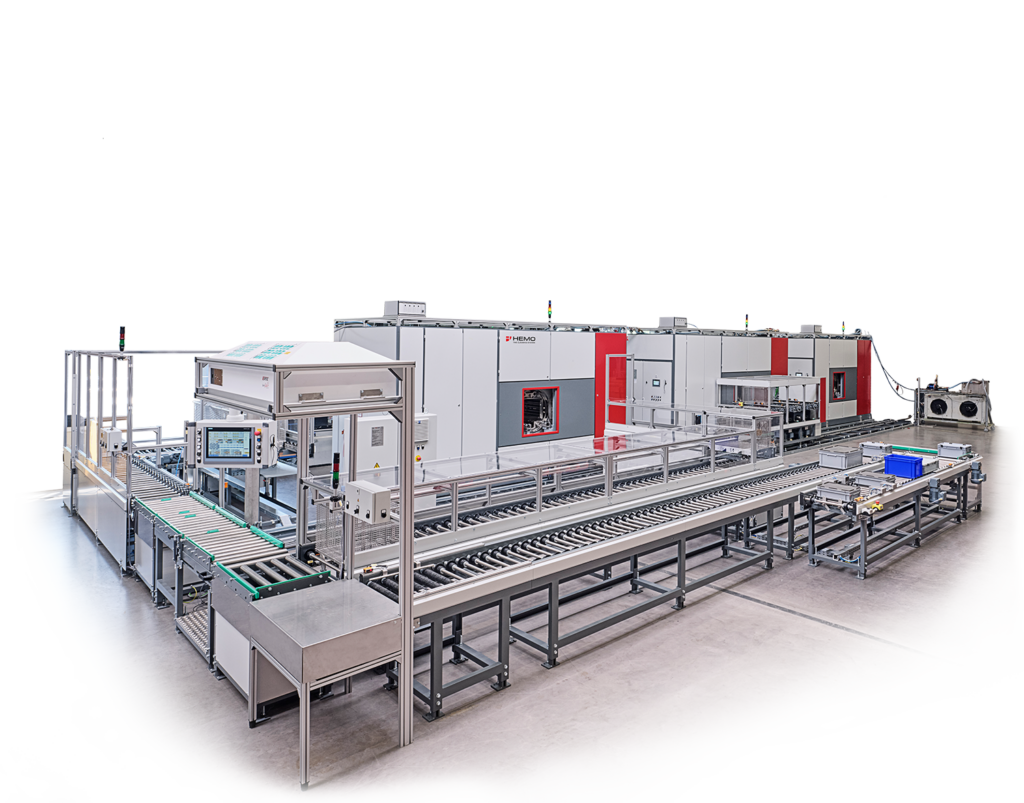
Practical example of a fully automated and interconnected fine-cleaning line for high-vacuum components with extreme requirements for cleanliness, process reliability, and throughput.
It reduces labor requirements, increases process reliability, and boosts efficiency.
Loading, cleaning, drying, preservation, media management, and quality assurance.
The system operates without manual intervention – all steps are program-controlled.
Via robots, conveyor technology, or automatic lifting systems.
Yes, depending on the component type, material, and level of contamination.
Via PLCs or industrial PCs with a touch panel and process visualization.
Automatic dosing, filtration, refilling, and recycling of solvents and water.
With vacuum or circulating air systems – depending on the type of system.
Yes, for example, by spraying or flooding with corrosion protection agents.
Through sensors, limit monitoring, and automatic logging.
Yes, modern systems detect faults early and report them automatically.
Yes, many systems offer remote access for service and updates.
Through integrated maintenance schedules and automatic reminders.
Yes, they comply with all relevant safety standards and are CE-certified.
Through intelligent control, demand-oriented media management, and heat recovery.
Yes, via interfaces with MES/ERP systems and conveyor technology.
Yes, via barcode scanners, RFID, or digital logging.
Very – they can be expanded modularly and adapted to new requirements.
Automotive industry, medical technology, aerospace, optics, semiconductor manufacturing.
Yes, through digital connectivity, upgradability, and high scalability.